LinkedIn: The "professional" network where critical thinking takes a backseat and everyone is an expert in everything.
Disclaimer: Obviously, your mileage may vary and it might be up to 100% of my fault that I receive the feed and content I do receive on LinkedIn. But as this is my blog - I am free to vent on how I see fit 😉
EDIT: It seems also that clicking the markdown citations doesn't work with Blazor very well. For all sources, just go to the bottom of the page. Clicking on the quotation will go to the homepage.
This post is "in the making" for a bit time - as in, I got more and more annoyed so I started writing this post on and off. I tried to collect some stuff that I found on LinkedIn that I found to be a bit ridiculous. And no, this isn't even about the default "I learnt This from ..." bs like
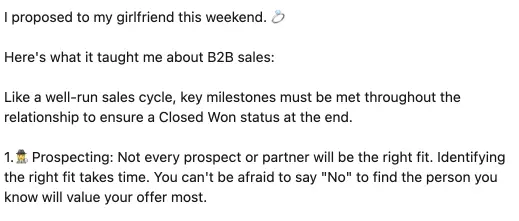
I proposed to my girlfriend this weekend. ??
Here's what it taught me about B2B sales ..
And I shit you not, that thing really exists. I wish it wouldn't.
On another disclaimer: I was super active some time back on LinkedIn as well - probably all the stuff I will write, did or does apply to me!
Simplifications is the pure mans expertise#
It seems that we are more and more unable to keep up a long attention span. Not only that our ability to filter out the noise1 is getting worse and worse.
Given an article from nationalgeographic2:
Our most recent study done over the past five years shows that the figure has gone down to 40 seconds
Given those two: (Over)simplified content with ideally "absolute" messages perfectly "fits" in our brain's attention span. As this gets clicked, shared and whatnot - the LinkedIn algorithm will push it to more and more people. So we are ending in a self-reinforcing loop of simplifications and "absolute" messages.
I even wrote some time back about "Use always a StringBuilder". Nice benchmarks inside the post so it looks "expert" to you! Or here another one:
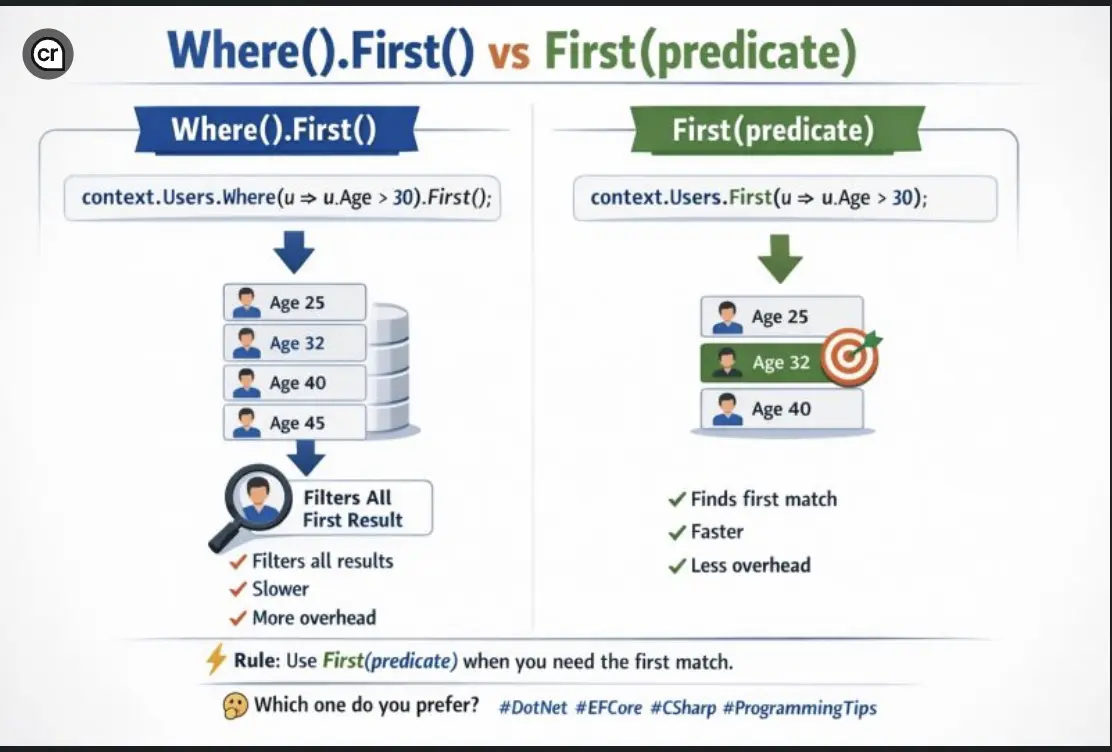
With this text:
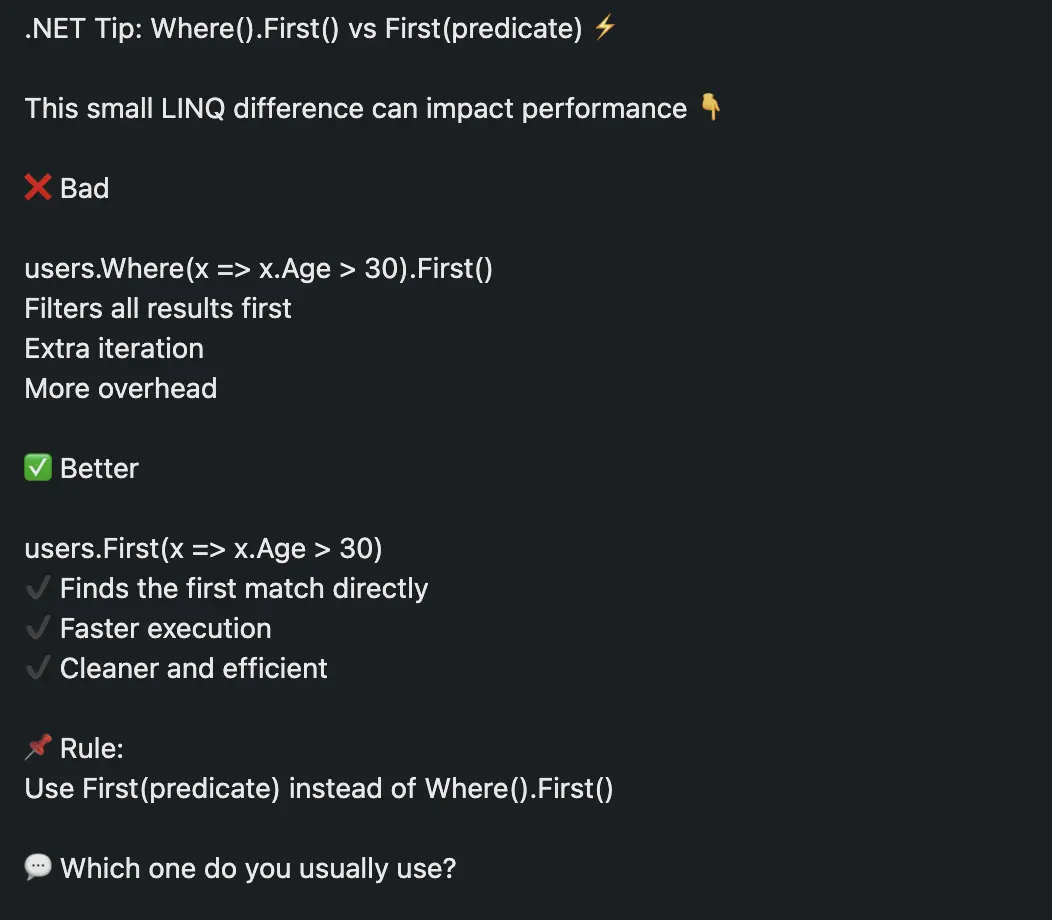
"GOOD" and "BAD". Very easy to digest. Still wrong, but that isn't the point (at some point I am planning to make a conference talk just with LinkedIn material and showcase how it actual works - but that means you have to listen 45 to 60 minutes to me rambling 😄). Given that people have many followers, it looks like that have the authority and the knowledge. As I said earlier, people then tend to not question the content and just accept it as truth. Reality is barely absolute - short LinkedIn posts just lack the context and nuance of the real world!
Bubbles, repitition and AI#
If you have a double digit IQ, you can utilize the LinkedIn algorithm to your advantage. Ideally you just copy (sometimes 1 to 1) content that is already there and literally also don't question the content of the original post. Just a few days ago this come to my "Suggested" feed:
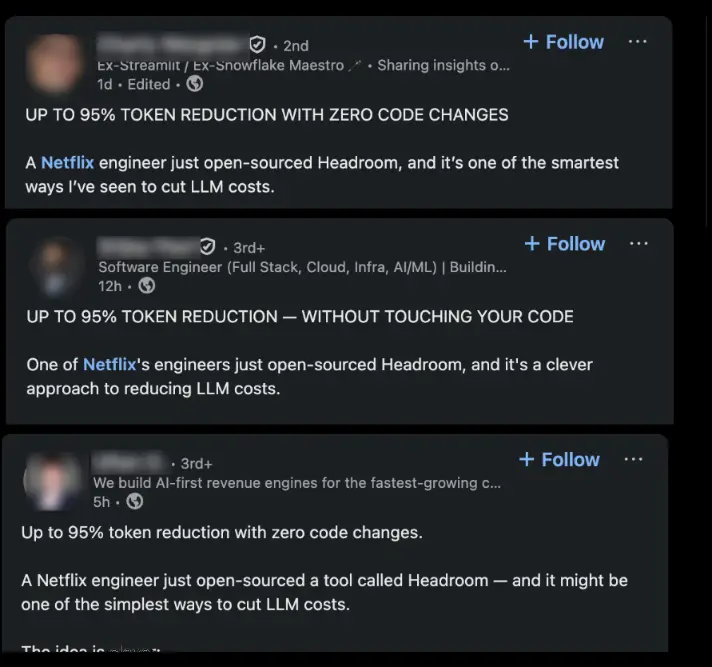
The only truth - 95% of the text is identical. Levenshtein distance of 5! Jesus. And there are more of those examples. Not only that but noone remotely questions the content of the authors message. Here another good one from the Tokenmaxing crowd:
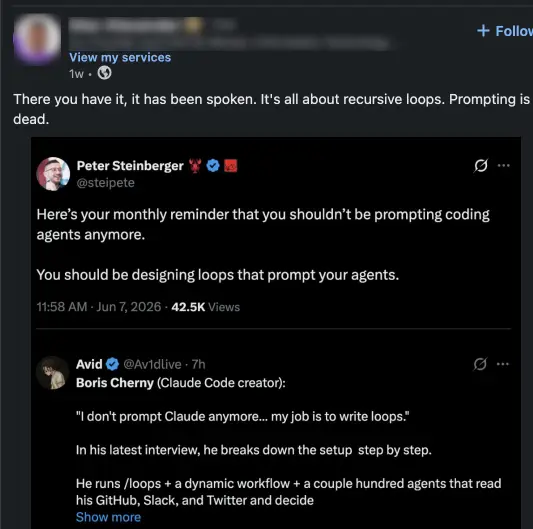
Yeah of course you should "loop" your agents. Maybe it is worth it - I don't know. Maybe I am not an expert, fair. But the creators of those messages have a big big interest in you "believing" in what is written. For example: Peter Steinberger3 is employeed by OpenAI. And guess what, they earn more if you
- rely more on them
- Use "Tokenmaxxing" as your strategy
Again - he could still be right. And it doesn't end here. There are posts where people "fanboyed" about speciifc products, without them even being released. Basically repeating the marketing message of the company.
But hey, maybe that happens when you overrely on AI bots which makes your critical thinking skills go down the toilet4. I don't know, free will.
AI wasteland - from AI for AI#
I assume you also noticed: >50% of content reads 100% AI generated. And of course. The comment section looks exactly like that. That is funny, given that people tend to dislike things written solely by AI5. But at least now we have an industry around it:

What is the point of having everything AI generated? Maybe it's just me who doesn't see it. I have my own business, so I get many many cold outreachs almost all of them written by AI. 100% of those that are written by AI are just bad and have absolutely no connection to what I am doing or what I am interested in. But sure: It is a numbers game. If you send out 1000 messages, maybe 1 or 2 will be relevant. I am not against using AI Tools - by far not, I am using them myself. But watering down the interhuman communication/connection with AI is the obvious shitty end of it.
Okay - enough ranting about AI, back to LinkedIn.
Influencers are not your friends!#
It is very very important to understand: People, especially you don't know from personal experience, that want to build a big audience: They are not your friends! And that is true for me (not that I am an "Influencer" but the fact that you are reading this, holds true for the information). They are always certain biases or agendas. For example: I have my own company - you can bet your beautiful money on the fact that I have a bias towards my own company, employees and services. Doesn't mean I outright lie to you, but for sure I will try to make my company look as good as possible.
And the same is true for influencers. Often times LinkedIn is just a big funnel (as in marketing funnel) to their newsletter or other channels. Why? Well - because they can sell ads much easier to a newsletter audience than to a LinkedIn audience. There are also many instances where people just promote products without even mentioning that they either got sponsored or are in some way affiliated with the company. By the way: That is illegal in many countries! That doesn't mean that you can't get value from the content or that the content is outright wrong. But it is important to understand that there is an incentive to "believe" in the content.
So where do we go from here?#
I don't know - I am not John Oliver and this isn't "Last Week Tonight". I just wanted to write down my thoughts and what is goind on from my PoV. That doesn't have to align with you or even be correct. So whatever you read, have a bit of distance to the content and don't just blindly believe in it.
Don't take LinkedIn literally - or broader: Don't take social media literally. A recent study published in the Journal of Computer-Mediated Communication6 evaluated how people process social media feeds. They found that when we look at platforms like LinkedIn, our brains calculate something called Perceived Toxic Positivity Intentions.
Basically, we decode whether a post is authentic or we perceive it as "fake" (as in not generous or authentic). In the study they came up with a few categories we perceive as fake (there are more and also posiitve ones, but here the ones I showed earlier):
- Inauthentic Self-Promotion like the "I proposed to my girlfriend, here is what it taught me about B2B sales" garbage
- Commercial/Personal Self-Promotion: Aka the Tokenmaxxing stuff
- Positivity/Expertise Promotion: The stringbulder stuff or the "GOOD" and "BAD" stuff. Basically, the content that is simplified to the extreme and lacks nuance.
The problem with this is that it can lead to "Upward Social Comparison". Because others do so much, we are comparing ourselves to them and feel like we are not good enough. That is especially true when you want to be "influencer" or "expert" (for a lack of better words) and you see others doing "so much more" than you. One mechanism to cope: Retaliating with your own false self-presentation. That is why so much content feels copy&pasted. And that in fact leads to bubble effects and that the Algorithm will push more and more of that content to you. It is self-reinforcing.
Long story short: Have some distance to the content you read on LinkedIn or in general.
-
Ophir, E., Nass, C., & Wagner, A. D. (2009). Cognitive control in media multitaskers. Proceedings of the National Academy of Sciences, 106(37), 15583-15587. PubMed↩
-
The average attention span has shrunk to roughly 40 seconds. Here’s how to get it back.↩
-
Rani, A., Danry, V., Liang, P. P., et al. (2025). Dialogues with AI Reduce Beliefs in Misinformation but Build No Lasting Discernment Skills. arXiv. https://doi.org/10.1145/3772318.3790656↩
-
Chu, H., & Liu, S. (2024). Can AI tell good stories? Narrative transportation and persuasion with ChatGPT. Journal of Communication, 74(5), 347–358. https://doi.org/10.1093/joc/jqae019↩
-
Salopek, A. H., & Eastin, M. S. (2024). Toxic positivity intentions: an image management approach to upward social comparison and false self-presentation. Journal of Computer-Mediated Communication, 29(3), zmae003. https://doi.org/10.1093/jcmc/zmae003↩